Rise of the Rat Queens
- Jamie Yonker
- 19 hours ago
- 6 min read
When I arrive at the massive outdoor space of the Bohemian Hall & Beer Garden in Astoria, Queens, it is populated with fighters in medieval metamorphosis. Some are shirtless, cinching their wide leather belts, stepping into pants that resemble quilted goalie hockey pads, fingers combing through long hair, choosing which method to pull it away from their face and into braids or buns.

Many of the fighters help each other dress from head to toe: tightening straps to their their most snatched ability, lifting heavy, historically accurate (1300AD-1500AD) helmets over their head before combat, and gently lifting them from their shoulders after they’ve been walloped by axes or swords. There is an intimacy I witness as a bystander, as it turns out, it isn’t so easy to assemble 50-70lbs of armor all by your lonesome. There is the subtle waft of sweaty cotton as the fighters saunter from picnic table to plastic chest of armor – maybe it adds to the authenticity, or perhaps it is just a reminder of the truth: this is a sport.
Today is one of the first exhibitions for the Rat Queens, the young femme medieval combat team under the NYC Armored Combat umbrella, which competes in a sport called buhurt, or in layman’s terms: “sort of like Medieval MMA,” named for the French term “to wallop.” Their team takes up a small space at one of the many picnic tables; only around four of the teammates are competing today, while the team’s roster hovers somewhere around ten.


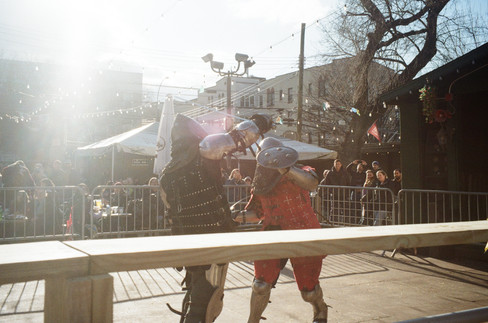


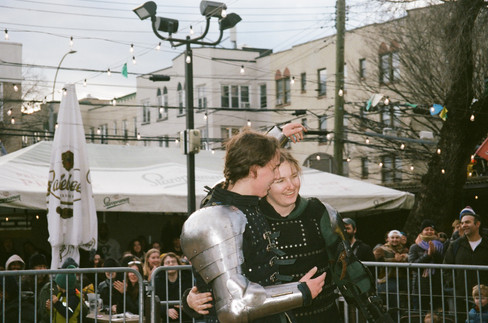
This afternoon also holds a personal first match for Nikki, a new fighter on the team. Nikki’s involvement is a brand of kismet; around two years ago, she and her girlfriend-slash-team-captain, Sophia, discovered medieval combat by chance.
“We were gonna go to the Met one day, and the line was crazy long, so I just said ‘fuck it’, and we went to Central Park,” Nikki shares of their first witnessing of the sport. “We stumbled on a bunch of people fighting [in armor] there. Then, pretty much within the hour, Sophia was like, ‘This is my new hobby.’”
Now two-and-some-odd years later, Sophia is the inaugural captain of the Rat Queens, nominated after competing on buhurt’s Team USA and taking home multiple gold medals at nationals. The team is still growing after a split from the conglomerate, The Waffles – a team that combined femme fighters from Boston and other surrounding cities, which dissolved in 2025 and made way for the hyper-local femme team: the Rat Queens.
“It's like, wait, no, we could all form local teams. Our goal was to get fighters' experience,” says Sophia of the separation. Since then, the Rat Queens have competed on the rooftop of the 14th Street Y, on off-duty Ren Faire grounds, and will be hosting Forged in Steel – the first all-femme ranked tournament in the US – in Elkton, Maryland at a historical Revolutionary War site on April 25th, 2026.
Soon, hundreds of beer-guzzling medieval combat fans are finding their way into the backyard of the Bohemian Hall; ambling with full pitchers of German lagers and gargantuan soft pretzels. The crowd exhibits the dedication of a rowdy, jawed WWE crowd, along with a strong presence of families toting young children. They slide into picnic tables, which fill up quickly, and leave the rest of the bystanders hovering around the large outdoor space with a great vantage point of the plywood ring, ready to record the violence that ensues.

Men in combat start the afternoon’s affair, and it is more grisly than I anticipated. One match concludes with an armored man pinned to the particleboard floor, getting an axe repeatedly bashed into his helmet. The clang rings throughout the patio, and the crowd goes wild. Small children clap their hands at the ring’s edges, and errant, “Do it again!” rings out. The announcer hollers into the crowd, “If you want to do this. If you want to fight. Get with them.” An open call for any rowdy crowd member, no gatekeeping, no barriers. Is it really that simple? Just simply… ask?
Curious about what the training entails, I am told it is currently held in an apartment gym. “We start with stretches and conditioning, all the usual ‘sports-type’ practice, you know, get yourself in shape,” says Nikki, “ Then we do a mix of different weapons training, we'll do SoftKit. We have foam and wood versions of the swords and the bucklers, and a helmet and everything. Then, at the end of our practice, we will go more into ground fighting and teaching people how to throw each other, teaching how to control your opponent, and keep your center of gravity in the right place.”
When armored-fighters-slash-teammates-slash-couple, Sophia and Nikki, take the ring together, weapons clash. The heft of their armor is heard through heavy stomps as they circle one another. Their swords hit small shields and pang against armored limbs. Ultimately, Sophia’s more successful after several rounds, which isn’t a massive surprise; she does hold a gold title worldwide in both lightweight and heavyweight buhurt divisions and has an impressive background in jiujitsu that lends a natural advantage. The referee calls the match in Sophia’s favor, and the couple pauses to kiss in the center of the ring. The crowd erupts in cheers. They want more kisses, stat.
“God, I love Medieval Times,” says a 20-something guy at my table listlessly.
This moment isn’t easily forgotten. It gives a genuine “BK/AK” divide to the evening – Before Kiss and After Kiss. From here on out, the crowd of hundreds chants “kiss, kiss, kiss” after the men’s matches, with very little luck in manifestation.
When I asked Nikki after the match how it felt to fight her partner in the ring, she said, “It was fun. I'm glad she didn't crush me. I talked to her beforehand, [and said] ‘Hey, just don't embarrass me, please.’”
I’m told that there are probably around twelve women’s teams in the country, but the sport’s presence is growing quickly. Armored Combat, in many ways, appears to still be in its toddlerhood, having made its way over to the States after its creation in 1980’s Russia. And it appears that, because of these Eastern European origins, two recurring issues I hear from the team – trans exclusionary practices and the inability to source armor reliably – are creating challenges.
The issue of women’s “open/closed” fights are brought up multiple times throughout the night in conversation. When visiting the Buhurt International’s tournament policies, the eligibility for Women’s Open Tournaments presently are:
1.4.1 All AFAB (assigned female at birth) competitors are eligible to compete regardless of gender identity, including cisgender women.
1.4.2 MTF (male to female) competitors are eligible to compete if they have been living as a woman for 2 years or more.
Some competitive teams choose to fight “closed,” meaning that they are choosing not to fight transfemme fighters. Nikki, a trans fighter, commented on this,
“There are a lot of trans fighters, a lot of non-binary fighters – especially in New York, there's a huge uptick of queer fighters. We need to let people compete in both, so that way no one is losing fights. Because that's my biggest problem with it is people are losing, like, half their fights, because one or two people don't want to fight transwomen. We can't have women's closed at the expense of women's open. We can't validate people's fears at the expense of other fighters. So we need to rank both. We need to let people compete in both. Dream scenario, we eventually get to a point where there's enough transfighters that it won't matter. And I think New York is starting to get in that direction.”
Most of the armor suitable for competition is coming from Ukraine and Russia (with the fighters choosing to order from Ukraine), and teams are running up against their trusted blacksmiths being drafted and, in turn, are receiving messages alluding to the fact that they will be gone for months, and in some instances, won’t return.
As it currently stands, the United States blacksmiths are not yet skilled enough at making buhurt armor, and as I am told by the team’s captain, “It’s not good enough, don’t trust it yet.”
Because of the lack of blacksmiths and the cost of a “kit,” it is difficult to get folks on the waitlist into armor and actively competing. A cheap kit will run you around $2,000, so there is much loaning/borrowing around these spaces. Many of the fighters are currently piecing together their armor by borrowing and loaning (lovingly referred to as “loaner gear”) and often not purchasing until a fighter is ready to sell and move onto an upgrade. When talking to Sophia, she said of her first kit, “It was boxy, it was ugly, I couldn't move well in it, but it was perfectly safe.”
Eventually, after dozens of rounds of combat, the night comes to an end. The sky has gone dark, the crowds have left, and all that remains are dark, sludgy puddles and empty beer pitchers. The teams sit at a long picnic table eating Bohemian’s faire in tandem– macaroni and cheese, pretzels, hearty German eats – because despite the few-hundred-person pull, the half-mile long beer line, the endless photo ops, the threat of physical violence, and the free entertainment, the teams tonight are only paid in German carbohydrates. For now, anyway.
The Rat Queens are open to new additions and can be reached at @ratqueensnyc. See them host and compete at Forged in Steel, the first all-femme ranked tournament in the US, on April 25th, 2026, in Elkton, Maryland.


Comments