At the Altar: Perennials in My Small Intestines
Katya Borkov
Article Details:
Katya Borkov
August 8, 2026
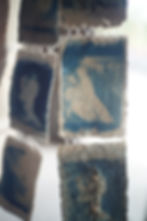
“The paper was made with the clothes of their deceased loved one. They’re arranged so that the photographs fade in clarity as you follow the row of images from left to right, beginning to end.”
I can hear the breaking of Jac’s voice. I can feel the tears well in my eyes.

We stand before Remembering Lilith (2025) by Andrea Matthews, a work that honors the memory of the artists’ trans sister. By making her loss visible, the fading images also make tangible the presence of grief. Both the image and the material unite in memoriam of the dearly departed, the intensive labor involved in their creation serving as a testament to the artist’s enduring love for her kin.
But this is not a space of sorrow alone. We have learned from those who came before that here, we must also come together to hold the hearts of the living. This is Perennials in My Small Intestines, a weeklong temple curated by Jac Clayton, which found its home in a glass-walled studio off the Morgan L in Bushwick, New York, this past June.

The exhibition brings together spiritually motivated queer artmaking practices spanning painting, sculpture, writing, performance, and photography. Honoring the gallery space as a living altar, Clayton invites moments of worship throughout the week in the form of private and public ceremonies: trombones, violins, and readings about the end of the world, the addition of objects to altarpiece installations like Jealyn Mc’s Kingdom of Heathens (2025), and shared meals between the artists, who gather to process, to grieve, to celebrate.

In Overlay: Contemporary Art and the Art of Prehistory (1983), Lucy Lippard identifies humanity’s repeatedly demonstrated desire, across both prehistoric and modern eras, to create art through ritual processes, producing monuments which serve as touchpoints to the divine. Breaking away from colonial presuppositions some forty years ago, she describes this “primitive” art as “the common language of the collective unconscious or political consciousness” (8).
So as the West’s secular age gives way to a new bout of religious fervor, it’s no shock that curators, creators, audiences, and institutions alike have all come to reemphasize the role of the sacred in art. In an age where God has been dead for some time, many go as far as to posit that artists have become the new saints. After all, a sort of cult can form around an artist’s ideology: disciples may teach their methods and circle around their icons long after they have passed.
But Perennials in My Small Intestines, in both its work and praxis, resists this contemporary movement’s tendency to pedestalize individuals as false idols. The exhibition pamphlet, printed as a series of take-home zines, opens with a poem by Clayton which asks, “Can you find someone in this room who is not already my God, I’d like to meet them and make them so.”
The Gods of Clayton’s universe are not omnipotent creators here to assert the way to salvation. They are a collective of friends, lovers, family members, whose creations stem from a shared need for meaning, remembrance, rebirth, and most of all, for each other. The mediums are varied– from Nicole Bartnikowski’s tapestry of self-portrait cyanotypes on seed paper (Foraging Through Roots 2025) to Rachel Wilkins’ abstractions of the dancefloor cast in shades of pink oil paint (Sanslalia, 2026).
But a common thread runs through these works, all of which were created to witness and venerate the divine force in one another, and in the world around them, regardless of the “literal shit and chemical fumes straight sulfide to the lungs” Clayton describes in their poem. In a world where many religious authorities deem the sacred expressions of Queer folk to be ungodly, going so far as to weaponize scripture against their love, kinship, and community, these artists reclaim the spiritual as theirs to define, steward, and express.

The room is arranged into a series of portals. Foraged string and sticks create the large mouth of a portal in Mari Fletcher-Lewis’ Ruttier (2026), demonstrating how even the most mundane of materials might still connect us to the sacred, seeing the value in what has been discarded and creating reverence from refuse. Aster Drewe’s play Sucking on Hard Candy(2026), which follows a mother and her two daughters as they face eternity beyond the apocalypse, spirals up towards the ceiling around a wooden chair, its pages parsing through the potentials and failures of divine justice, petitioning the powers that be to avenge their fallen kin.
Though the space is quiet when I visit, a chant draws the ear to the north west corner of the space, emanating from Troizel’s in the swamp, god is our sister (2026). I am a transexual…I had a transexualism operation…I am no longer a man…I had a sex change…I am a woman. Created as a tribute to Ashley Moore, Troizel’s video installation intersperses archival footage alongside clips of the artist in her studio and imagery of the sacred swamp that inspired her work. As the footage goes on, the chants give way to the sound of a song: I am what I am, I am my own special creation…
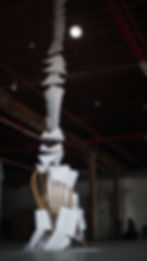
Circling back to the chair around which Drewe’s pages swirl, Jac and I stand still for a moment, holding our breath as we stare across the gallery’s open door: a threshold into the real, violent, mundane, and beautiful world out there. We wait for a slight breeze to blow through the entryway, so the papers suspended by strings from the ceiling might too sing us their song.
In a city where space and time are hard-earned commodities, the exhibition would only be up for a week longer. The chair will be sat in, and the play whose pages have been carefully threaded around it will be read from floor to ceiling. The altar will grow larger, as loved ones drop in to add candles, talismans, dildos, and photographs. The artists will gather for breakfast and sit cross-legged on the ground with the reverberations of all they’ve shared and seen and felt here.
This is how we make our altar.
We love, we remember, we create, we witness.
Should the sanctuary stand for a week or a century, the love that it carried is still here; you can feel it.
Photos by Leo Koulish and Jaelyn Mc